
A podiatrist’s work boot checklist: 12 features to assess
FIT & ADVICE / PODIATRIST CHECKLIST
Assess a work boot as a complete system: where it bends, how it resists twisting, how it holds your heel and whether its shape, cushioning and arch support suit your foot. Start with your workplace’s required safety protection, then use the 12 checks below to compare fit and construction.
Adapted from the original Docpods guide by Kent Elliot, Podiatrist. This detailed assessment checklist complements our quick work boot buying guide; for current models, prices and availability, visit the work boot collection.
12 checks for work boot support and construction
Use these observations to compare boots in person. They help you assess fit and construction; they are not a substitute for the model’s documented safety certification or an individual fitting assessment.
1. Where does the work boot bend?
The boot should only bend where your foot bends (at the joint of the big toe). This helps the foot to function in the normal heel-to-toe motion in walking.

2. Where does the work boot Twist?
The boot should resist being twisted (wrung out). When walking on uneven ground, having a work boot that is resistant to twisting will keep your foot in a more neutral and rested position.

3. Heel Counter in a work boot
The heel counter should be fully enclosed and firm. In our boots, we have made this more mouldable as we often have customers that need to fit a wider foot in the boot. The leather construction heel counter will adapt to the foot shape but also offer support.

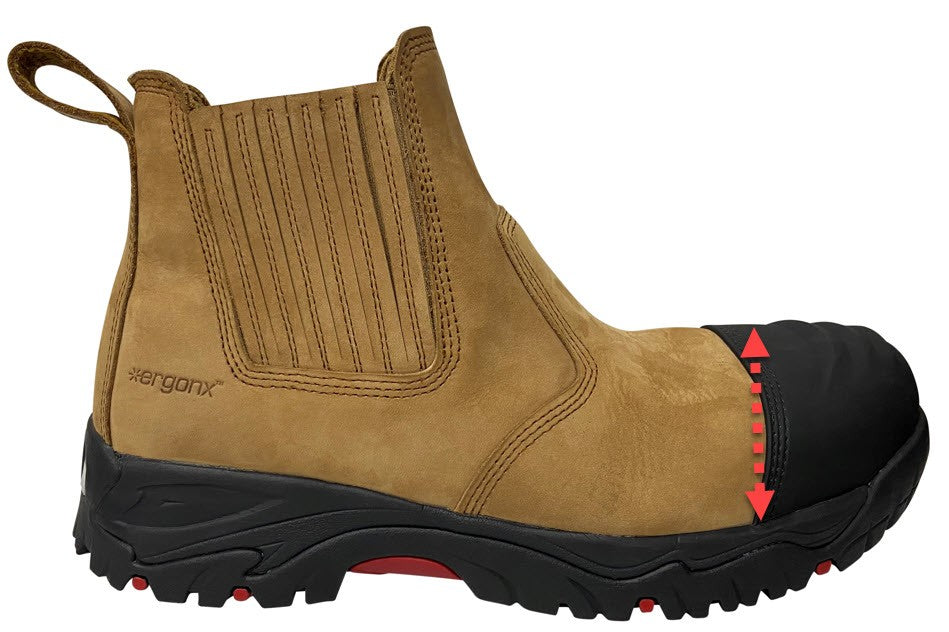
4. Toe Box in a work boot
The toe box region should be deep and roomy to accommodate wide and deep feet.

5. Length of the work boots
The boot should be a thumb width longer than the longest toe. You can check this against the length of the insole in the boot. If your toes touch the end of the insole then the boot is too small.

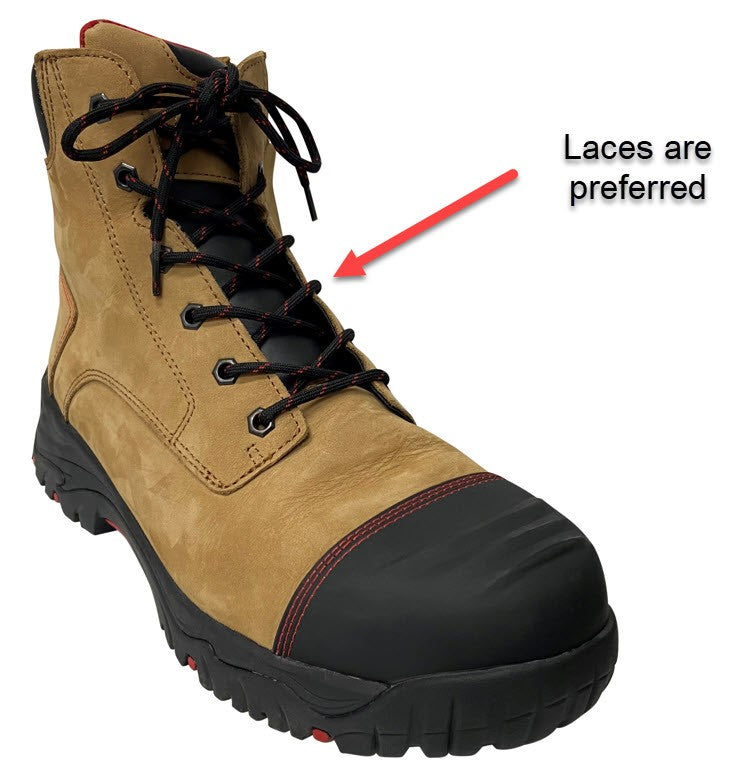
6. How is the safety boot fastened to the foot
Ideally, the boot should be able to be fastened to the foot by a buckle, belt, strap, elastic, or laces. Our preference is for laces and zip as you can have the benefits of a slip-on (zip-on) and then as the boot leather stretches over time, the boot can be tightened with the laces to fit the foot.
7. Heel Height in safety boots
A small raise helps to relieve some of the pressure on the calves and Achilles when working. It will also help to limit over-pronation in workers with tight calves. Limiting pronation will help to prevent wear and tear on the joints ligaments and muscles of the feet.

8. Shape of the work boot matches the foot
The shape of the boot should match the foot (curved last for a curved foot). If the shape of the boot does not match the foot, the boot can be uncomfortable.

9. Midsole of the safety boot and work boots
The midsole of the boot should be solid/firm yet shock absorbing. When the midsole is shock-absorbing the boot cushions more of the impact and so it is not transferred to your feet and knees leading to wear and tear.
Only the best work boots have the ideal mix of a midsole that is soft but not too soft for shock-absorbing, and firm but not too firm so the shoe will wear well. The midsole does need to be an all-rounder when it comes to function.

10. Flat Outsole Forefoot to Rearfoot
Is the shape of the outsole flat on the forefoot with respect to the rearfoot? This keeps the foot aligned and will keep the stress and strain on the midfoot and heels to a minimum.

11. Arch support
Adding supportive soft arch support to a work boot will help to limit overpronation, reduce foot fatigue and make for a more comfortable work day. The Ergonx boots support the medial arch, lateral arch, and transverse arch of the foot. This limits abnormal movements so your feet are more comfortable on any job site.

12. Durable, Lightweight, and protection
In addition to the above, the shoe should be durable and lightweight and offer protection to the foot and toe area of the wearer (using a steel cap/fiber cap). How rugged the boot is will depend on the quality and type of construction. The weight will also depend on what features are included in the boot.

Turn the checklist into a shortlist
- Confirm required protection. Check your employer’s specification before comparing comfort features.
- Try your normal setup. Wear your usual work socks and bring any prescribed orthotics. Check both feet and assess heel hold, toe space and movement.
- Compare the complete boot. Record which checks work for your foot rather than choosing solely on softness, price or a “podiatrist recommended” label.
Compare widths, fit and features · Choose around your job · Read about foot discomfort at work
For current safety specifications, available sizes and prices, open the exact product in our work boot range. Women can compare the dedicated women’s fit and standard wider options in the women’s work boot guide.
About the original author
Kent Elliot, Podiatrist — B App. Sc. Pod (Hons), B.Sc (HMS), M.A. Pod. A.
Kent has worked as a podiatrist since 2003. He graduated from the University of Queensland in Human Movement Studies and studied podiatry at QUT. His original guide explains the design considerations behind the Ergonx work boot range.